

Midsize winter church outfits can be warm and polished without piling on heavy layers. Start with a thin thermal base under a midi dress or long tunic, then add tights or trousers, boots with reliable grip, and a coat that closes comfortably. A simple scarf can provide warmth without overwhelming the outfit.
Think through the whole Sunday: the cold walk from the car, time sitting indoors, and lunch afterward. This guide covers breathable layers, coat lengths, practical footwear, and outfit formulas you can repeat during December and January.
Three warm winter church outfit formulas
- A-line midi dress + thin thermal layer + opaque tights + grippy knee-high boots.
- Slim stretch trousers + long tunic + tailored wool coat + secure scarf.
- Knit dress + lightweight cardigan + belted coat for the walk from car to church.
1. Start With a Thin Thermal Base Layer
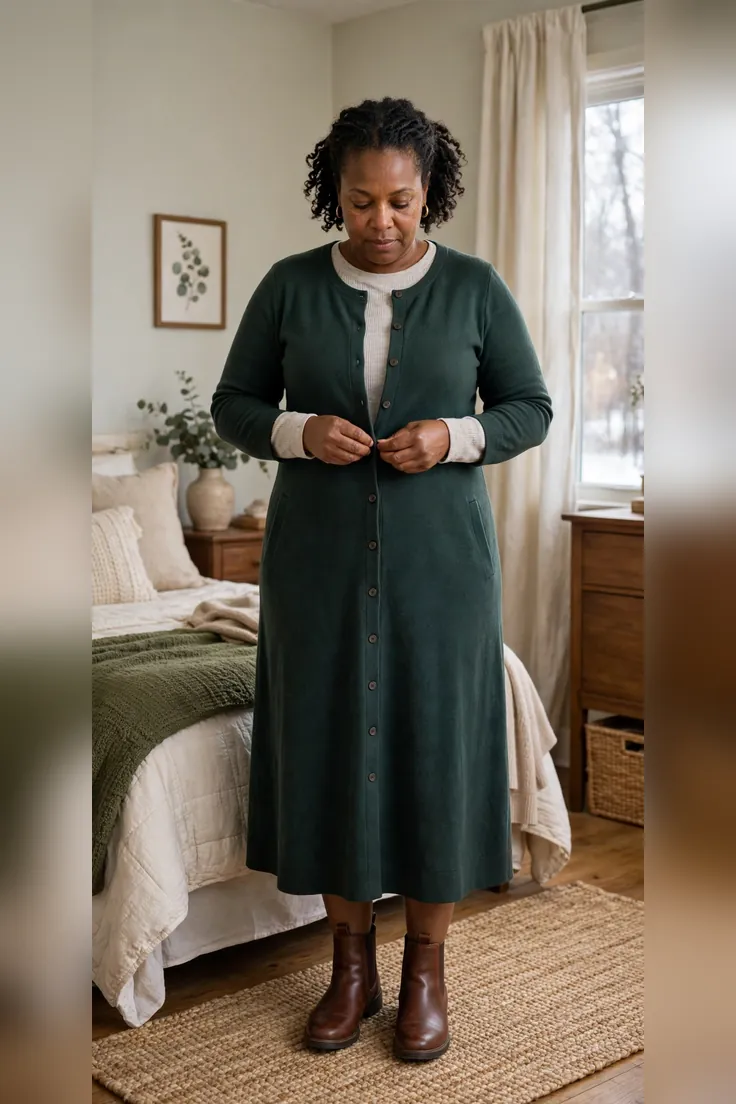
A good thermal sits like a second skin, traps heat right against your body, and disappears under everything else you wear. Look for a smooth, lightweight fabric that does not bunch at the waist, and choose your usual size rather than sizing up.
Wear it under a dress, a tunic, or a blouse, and you will feel the difference before you even put your coat on. The moment your base layer gets thick or fleecy, it starts competing with your outfit instead of supporting it.
2. Choose a Base That Skims Your Figure
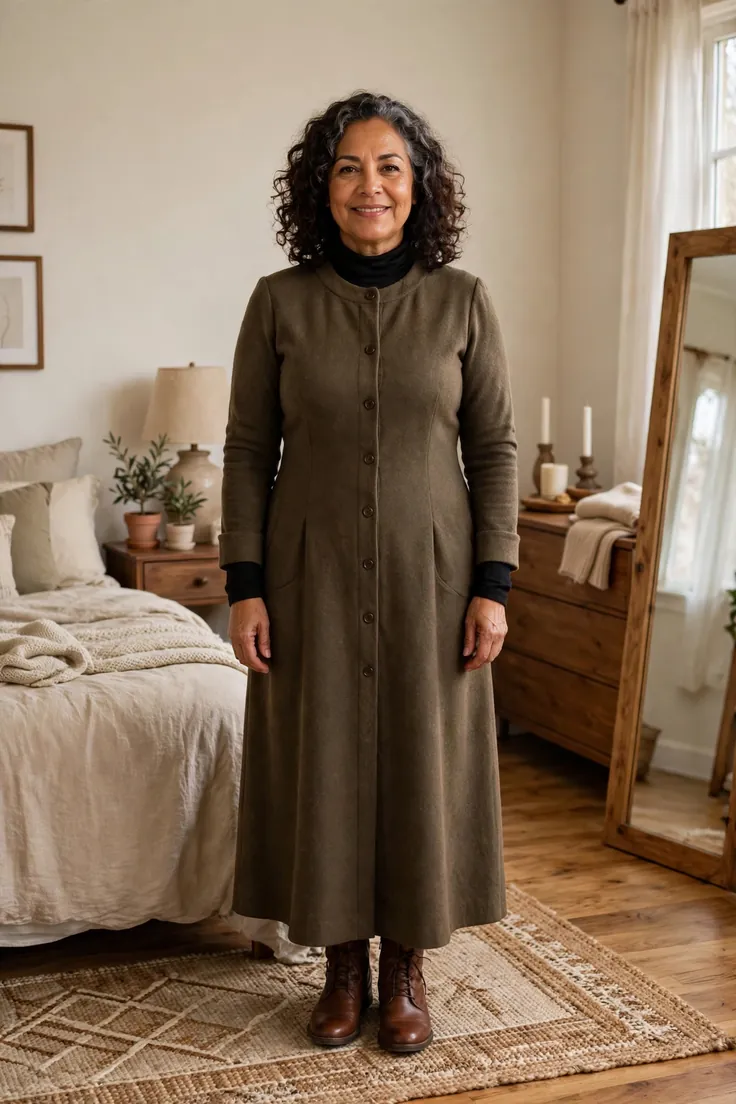
Not every thermal is cut the same, and the cut matters more than the brand name. A base layer that skims your figure will lie flat under a dress and will not create ridges at your waist or under your arms.
Black under black, nude under light colors. It sounds fussy, but this is the layer nobody sees, and that is exactly why it has to be right. When the base disappears, the outfit on top gets to shine.
3. Pick a Dress With Room for Layers Underneath

The dress you choose in December is not the dress you choose in May, and pretending otherwise is how you end up cold and squeezed. A-line and fit and flare shapes are your friends here because they give you movement without giving you width.
Hold the dress up and ask one question: can I sit in this for an hour without adjusting it? If the answer is yes, it will layer well. If the answer involves tugging, pick another dress. Comfort in the pew is not a bonus.
4. Let a Midi Length Keep Your Legs Warmer

A midi length that falls below the knee covers the part of your leg that a knee length dress leaves bare, and that one change can be the difference between comfortable and chilled by the second reading.
Pair a midi dress with warm tights and boots, and your lower half is basically sorted. You do not need a maxi to stay warm, and a maxi can trip you on church steps anyway.
5. Wear Slim Trousers Under a Long Tunic
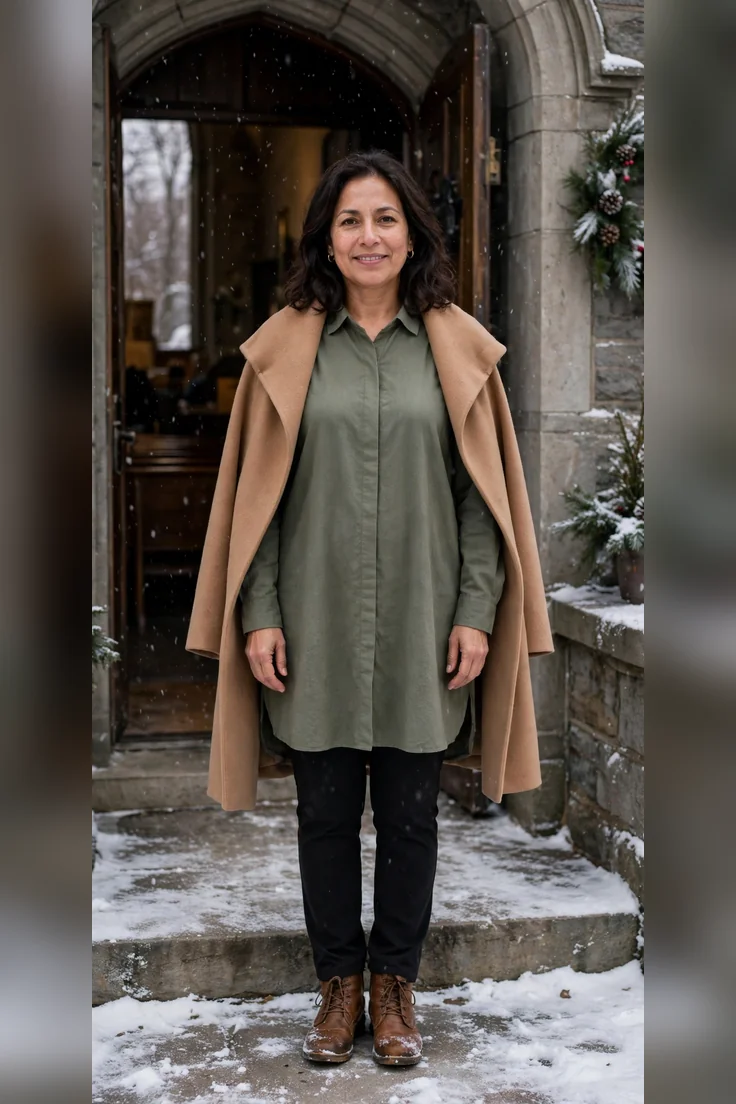
The tunic covers your hips and gives you the coverage you want, while slim trousers keep the silhouette neat instead of wide. The key word is slim, not skin tight. You want a clean line, not a squeezed one.
Choose trousers in a ponte or stretch wool that hold their shape through a long sit, and make sure the tunic falls past your hip bone. That length is what keeps the outfit looking intentional rather than accidental.
6. Keep Your Waist Defined Under Layers
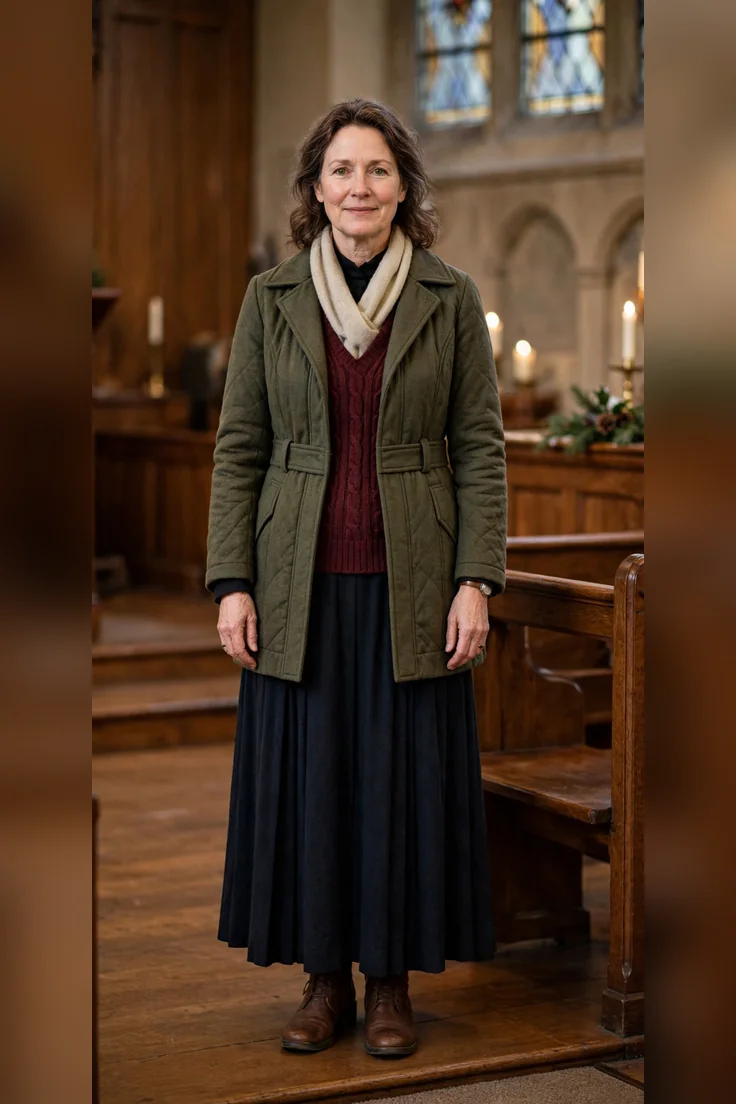
Fix this by giving your waist one clear marker in every outfit, even if that marker is subtle. A dress with a defined waist seam, a tunic belted loosely, or a cardigan that closes at the waist all do the job.
You just need the eye to find your waist without hunting for it. Try your outfit on, add each layer one at a time, and check the mirror after each one. The moment your waist disappears, that layer is the problem, not your body.
7. Belt Your Coat, Not Your Sweater
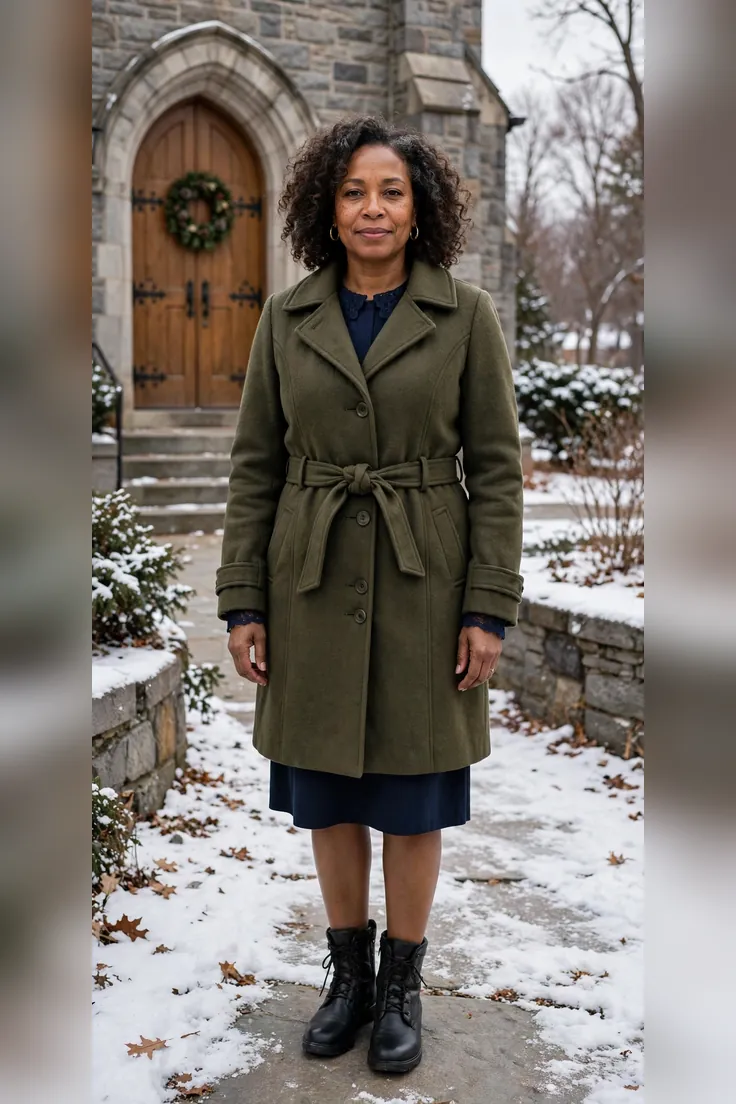
A belt worn over a coat pulls the whole outfit together and stops a long coat from looking like a shapeless tent. It also means you do not need a belt on every layer underneath, which is where bulk usually builds up.
Choose a belt in a similar tone to your coat so it reads as part of the coat, not as an extra accessory fighting for attention. Wide or slim? Slim is easier to sit in, and you will be sitting for a while.
8. Choose a Coat That Closes Without Pulling

A coat that gaps at the front is not keeping you warm, and it is not doing your outfit any favors either. When you try on a coat, button it fully, sit down in it, and raise your arms.
This is worth spending a little more on, because your coat is the piece everyone sees first. A well fitting coat in a classic shape will carry you through Christmas, January, and plenty of winters after that.
9. Pick a Coat Length That Covers Your Knees

Coat length is a warmth decision disguised as a style decision. A coat that ends at the hip leaves your thighs and knees out in the cold on the walk from the car, and no amount of tights fully makes up for that.
If you are petite, look for a knee length coat rather than a full length one so you do not get swallowed. Knee length is the sweet spot for most midsize figures, warm and walkable at the same time.
10. Layer a Short Cardigan Under a Longer Coat
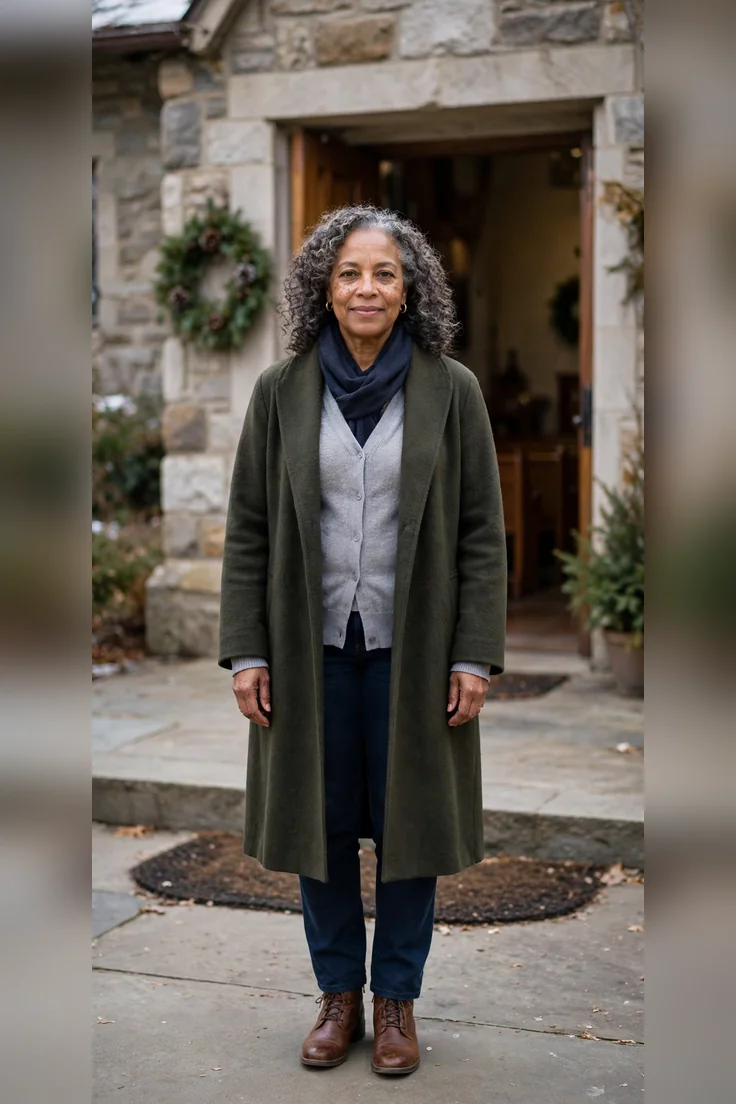
A short cardigan under a longer coat adds warmth around your torso without adding length or bulk at your hips. Its shorter length also stops fabric from bunching at your waist when you sit down.
Pick a fine knit cardigan rather than a chunky one, and wear it open or closed depending on how warm the church runs. Churches are famous for being either freezing or overheated, sometimes in the same morning.
11. Add a Vest for Warmth Without Sleeve Bulk

A vest warms your core, which is where your body actually needs the heat, and it leaves your arms free to move inside your coat sleeves. A quilted vest, a knit vest, or a fleece lined vest all work under a coat.
Wear it under a coat and over your dress or tunic, and take it off inside if the church is warm. It is the easiest layer to add and remove, which makes it perfect for a morning that starts freezing and ends stuffy.
12. Choose Sleeves That Slide Inside Your Coat
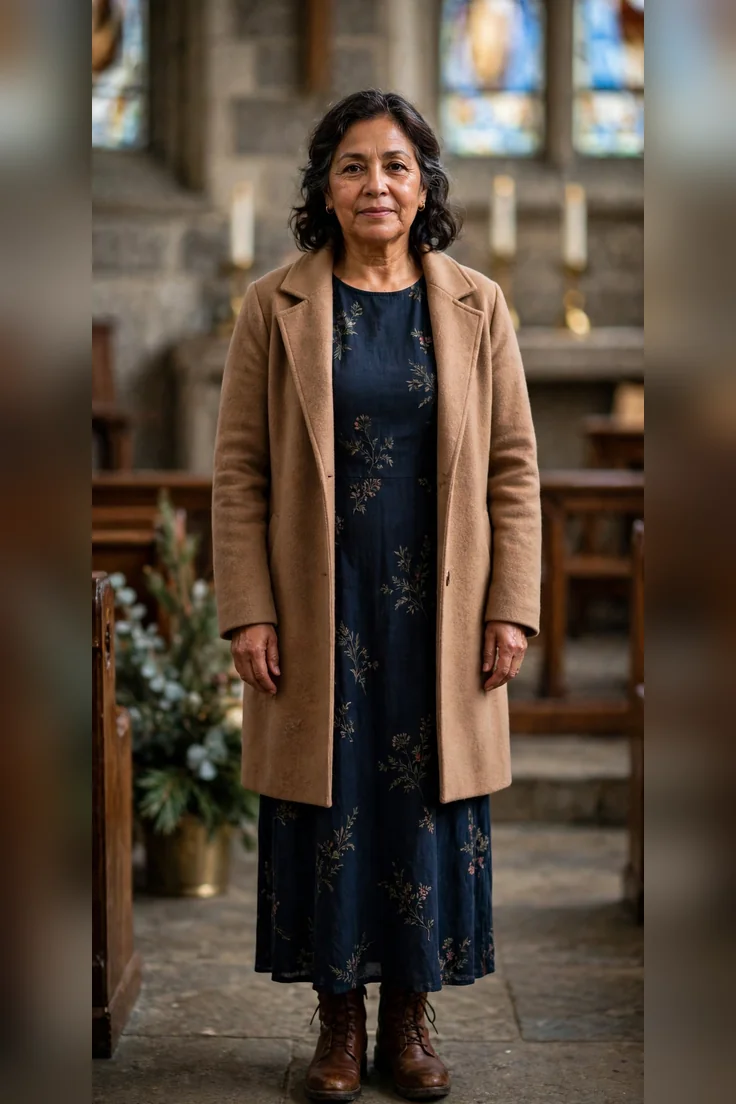
Save yourself the struggle by choosing sleeves that slide easily inside your coat. Slim long sleeves, three quarter sleeves with a warm layer underneath, or a sleeveless dress with a fitted cardigan all work beautifully.
Try the combination on at home before Sunday, coat and all. Slide your arms in, sit down, and reach forward like you are picking up a hymn book. If anything bunches at your elbows or pulls at your shoulders, change the sleeve, not the coat.
13. Keep Your Neck Warm With a Scarf That Stays Put
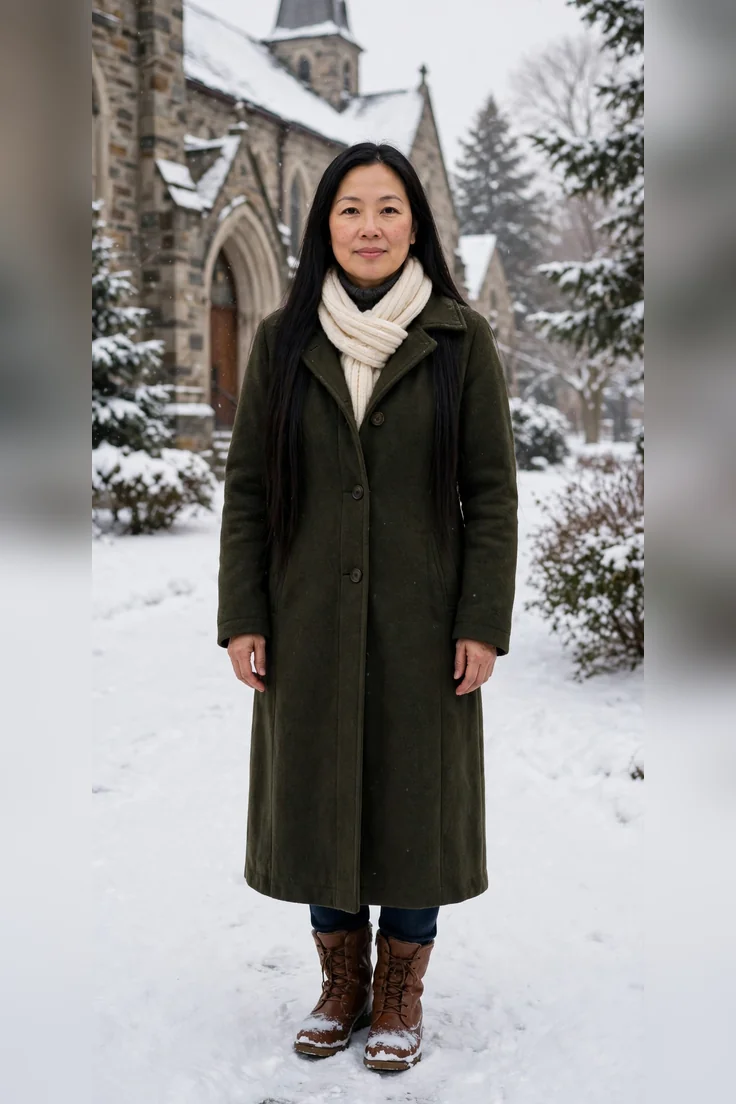
The fix is simple: choose a scarf long enough to loop twice around your neck, and tuck the ends inside your coat. That loop holds itself in place, keeps your neck warm, and will not unravel in the wind.
Wool and cashmere blends hold a loop better than slippery silk, so save the silk scarf for indoors. And here is a bonus: a scarf worn this way frames your face beautifully in photos after the service. Warmth and a good photo in one accessory?
14. Pick a Scarf That Adds Color, Not Bulk

A scarf is the easiest place to add color to a winter church outfit, and color near your face brightens everything. But a giant blanket scarf can add visual bulk right where you do not want it, around your neck and chest.
Deep red, rich green, or a warm plum all look lovely in church in winter, and they photograph beautifully too. One strong color is more striking than five competing ones, and it keeps your silhouette clean.
15. Wear Tights That Actually Keep You Warm
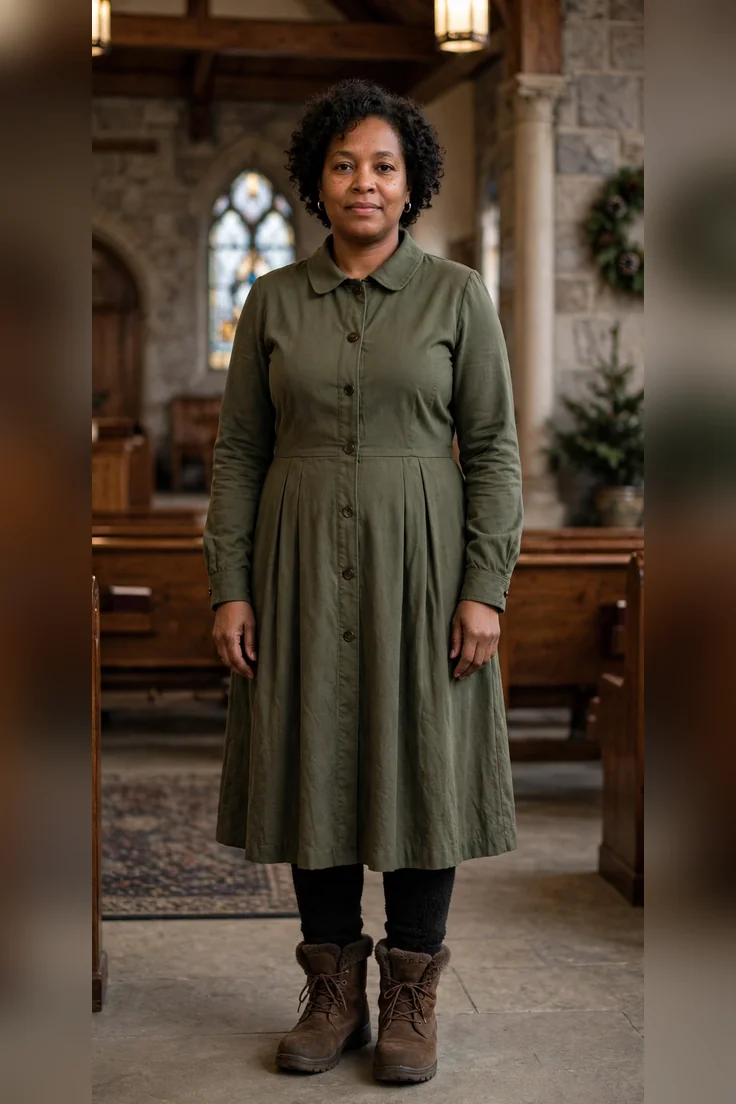
Regular sheer tights are not winter tights, and pretending they are is how you end up cold by the second hymn. Fleece lined tights look like ordinary opaque tights from the outside and feel like a warm hug on the inside.
Look for a denier count that feels substantial, and try them on with your boots before Sunday so you know they do not slide down. A pair that stays up all morning is worth its weight in gold.
16. Choose Boots With Grip for Icy Steps

Church steps in winter are beautiful and treacherous in equal measure, and the wrong sole turns a graceful entrance into a careful shuffle. Look for boots with a rubber sole and a real tread pattern, not a smooth leather sole that slides on ice.
A block heel gives you height and stability at the same time, which is a far better deal than a stiletto on an icy morning. Safe and stylish is not a compromise. It is just smart.
17. Pick a Boot Height That Works With Your Hem
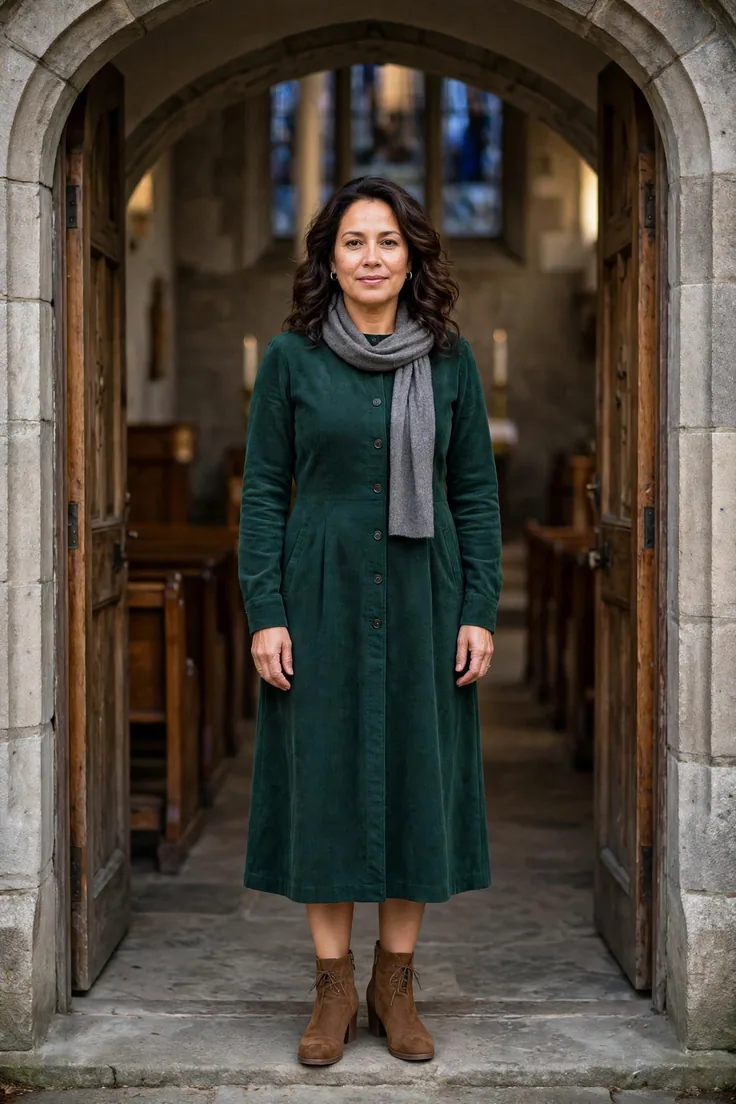
Ankle boots, knee high boots, and everything in between all work for church, but they work with different hems. Ankle boots pair beautifully with a midi dress because they show a little leg and keep the outfit balanced.
The mistake to avoid is a boot that ends right at the widest part of your calf under a hem that ends nearby, which chops your leg into awkward sections. Does it flow? Then it works.
18. Keep a Second Pair of Shoes for Inside

A second pair of shoes solves both problems. Keep a pair of simple flats or low heels in your bag, change when you get inside, and slip your boots back on for the walk home.
This sounds fussy, but it is actually a lovely little luxury, and your feet will thank you by the final hymn. Choose flats that fold flat or pack small, and pick a color that works with your outfit so the swap looks intentional.
19. Sit Comfortably Through a Long Service

Here is a test most outfit advice never mentions: sit in your full outfit for twenty minutes at home before Sunday. Church pews are not forgiving, and an outfit that feels fine standing can dig, ride up, or pinch once you sit.
Do the sit test with your coat off, the way you will actually sit in church, and fix whatever bothers you now. Twenty minutes of testing at home buys you a whole peaceful service, and that is a trade worth making every time.
20. Choose Fabrics That Do Not Wrinkle in the Pew

Some fabrics look perfect in the mirror and terrible after an hour in a pew. Linen and thin cotton crease badly, while ponte, wool crepe, and good knit fabrics bounce back even after a long sit.
Do a quick wrinkle test at home: sit on the fabric for ten minutes, stand up, and look. If it looks like you slept in it, save it for a standing event. Church is a sitting event, and your fabric should know that.
21. Carry a Bag That Holds Your Extra Layer

Winter church outfits often come with extras: a scarf you take off inside, gloves, a spare pair of flats, maybe a wrap for later. A bag that actually holds these things saves you from juggling them in the pew.
Keep the bag organized the night before so Sunday morning is calm. Gloves in one pocket, flats at the bottom, scarf on top where you can reach it. A calm Sunday morning starts with a packed bag on Saturday night.
22. Plan a Coat Check Strategy for a Small Church

Not every church has a coat room, and small churches often have a row of hooks in the entrance hall instead. Plan for that. Wear a coat that hangs neatly on a hook, and keep your outfit underneath complete enough to stand on its own.
A scarf looped and tucked, a cardigan buttoned, and a dress that looks finished without a coat all help here. Walk in, hang your coat, and walk to your pew looking like you meant to do exactly that. Because you did.
23. Dress for the Walk From the Parking Lot

It is easy to dress for the church interior and forget the walk that gets you there. That walk might be across an icy lot, up a hill, or down a windy street, and it is often the coldest part of the morning.
Once you are inside, you can shed the hat and gloves and let the outfit underneath take over. But if you skip the walk gear, you arrive cold and stay cold, because it takes a long time to warm up in a drafty church.
24. Keep Your Hair Neat Under a Hat and Scarf

A low bun, a smooth blowout with a little hold, or soft waves pinned back will survive a hat far better than a high, fussy style. Put the hat on gently, and take it off gently too, no yanking.
Keep a small comb in your bag for a quick tidy in the entrance hall, and do not be shy about using it. A two minute tidy turns hat hair back into a hairstyle, and you walk into the service looking fresh.
25. Choose Jewelry That Survives Layers and a Coat
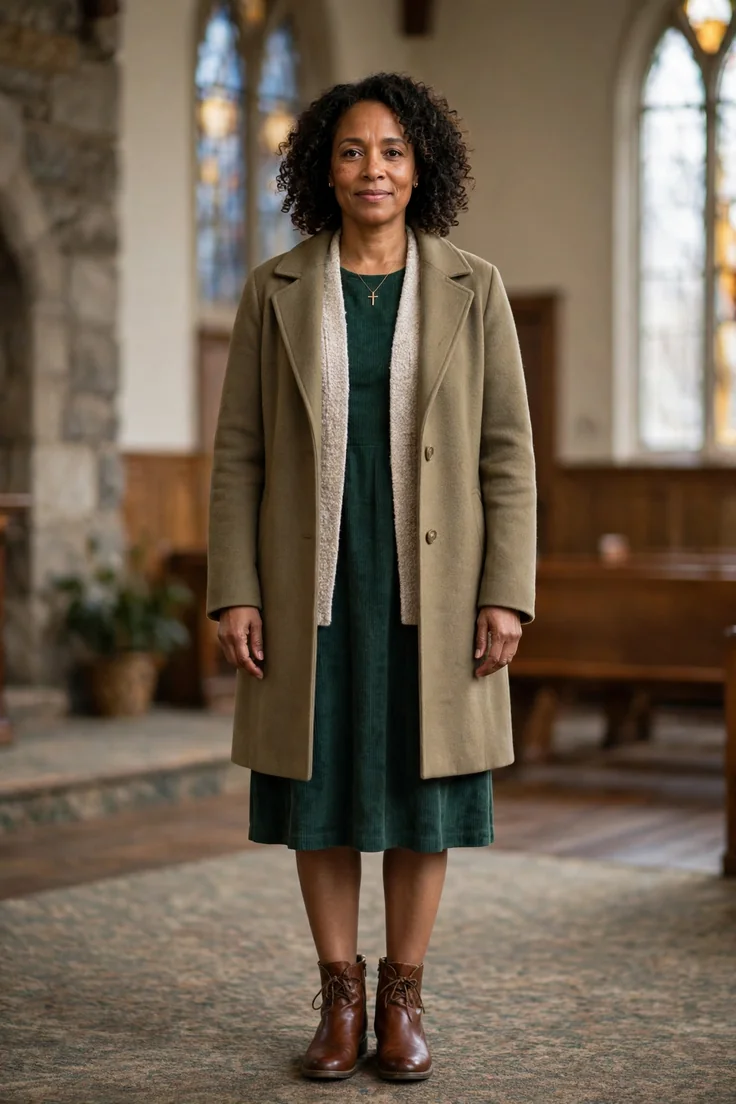
Delicate necklaces get lost under scarves, and big bracelets catch on coat sleeves. The jewelry that works best for winter church is simple and sturdy: stud earrings, a pendant that sits above your neckline, or a ring that does not snag.
Put your jewelry on after your scarf and coat are sorted, so nothing gets tangled in the process. And if you love a statement piece, save it for the indoors part of the morning and put it on once your coat is off.
26. Build One Formula for Christmas and January

You do not need a new outfit for every winter Sunday. You need one formula that works, and a few variations on it. Start with your best base layer, your favorite midi dress or tunic, warm tights, boots with grip, and a coat that closes.
This is how you get through Christmas and January without a closet full of one wear wonders. One formula, worn with confidence, beats five outfits you are not sure about. Write down a formula that keeps you warm and looking like yourself.
27. Test Your Outfit Sitting Down Before Sunday

We said it before, and it is worth saying again as its own step: test the whole outfit sitting down. Sit in a chair for twenty minutes, the way you will sit in church, and notice everything. Does the dress ride up?
This test is the difference between an outfit that looks good in a mirror and an outfit that feels good for a whole service. And feeling good is what lets you focus on the service instead of your clothes.
28. Pack a Warm Wrap for After the Service

A warm wrap, a pashmina, or a soft shawl that you keep in your bag gives you an extra layer for exactly this part of the morning, without committing to it for the whole service.
A wrap also looks lovely over a church dress, which is a nice bonus. Think of it as your after service layer, small to carry, big on warmth, and the perfect ending to a well planned winter church outfit.
Frequently Asked Questions
How many layers do I actually need for a cold church morning?
Three thin layers usually beat one thick one. A thermal base, your dress or tunic, and a coat give you warmth without bulk, and you can add a cardigan or vest on the coldest days.
Can I wear a midi dress to church in January?
Yes, a midi length covers your knees, pairs beautifully with fleece lined tights and boots, and looks elegant in church. Just make sure your coat covers your knees too, so the walk from the car does not undo the warmth your dress gives you.
What boots are safe on icy church steps?
Boots with a rubber sole and a real tread pattern are your safest bet, and a block heel gives you height without the wobble of a stiletto. Skip smooth leather soles on icy mornings, and you will enjoy the walk in much more.
How do I keep my waist defined under a coat?
Put your waist marker on the outside, not buried underneath. A belt worn over your coat, a coat with a defined waist seam, or a dress waistline that shows when the coat opens all keep your shape visible.
What should I do if my church is overheated inside?
Dress in layers you can remove without a fuss. A cardigan you can open, a vest you can slip off, and a scarf you can tuck away give you control as the room warms up.
For more outfit inspiration, explore Christmas church outfit ideas for women over 50 and warm midsize winter outfits.
Closing
Cold winter church mornings do not have to mean choosing between warmth and looking like yourself. A thin base layer, a dress or tunic with room to move, a coat that closes, warm tights, and boots with grip will carry you through Christmas and January in comfort.
